by Elizabeth Cazares | Feb 24, 2021 | Nutrition
Just like that, Thanksgiving has passed and we’ve come into the winter season! Speaking of winter, there’s all kinds of delicious winter produce available. Pineapple is actually a winter fruit! Snack on pineapple while you imagine yourself on a warm beach in Hawaii.
There are many benefits when it comes to buying in season produce.
- Price
- In season produce is less expensive than out of season produce and it’s also fresher.
- Environmentally friendly
- When produce is in season, it doesn’t have to travel as far to get to you which leads to less transportation and air pollution.
- Variety
- Buying in season produce will help to give you a variety fruits and vegetables which leads to a variety of nutrients and phytochemicals.
What about frozen produce?
Frozen produce is actually a great alternative to the fresh produce. Frozen produce is picked at its peak ripeness and flash frozen maintaining all the vitamins and minerals and can be budget friendly and time saving too. Frozen veggies like potatoes, broccoli and cauliflower already have the chopping done for you!
Fresh vegetables have a life span of 1-2 weeks whereas frozen vegetables last longer. Buying frozen out of season produce can be great as it’s packaged while it’s in season.
Don’t forget your seasonal produce guide during your next grocery trip!
– Elizabeth Cazares, RD
by admin | Feb 24, 2021 | COVID-19
During these current unpredictable times of COVID 19, staying connected has been more important than ever. We as human beings have a natural need for connection that shows up in many ways in our lives. From the underlying needs associated with driving behaviors to our casual desire to spend time with our loved ones, connection is a relatable need. Yet feeling disconnected is something which plagues so many people.
Feeling disconnected can have many origins. We feel isolated when we are depressed. We feel barriers between us and other people when we are anxious. Traumatic experiences cause us to feel hypervigilant around people or make it difficult to trust. Ambivalent or anxious attachment styles from caregivers during childhood lead to feeling as though we cannot have healthy connections with others. Regardless of why we feel disconnected, it is a common experience for many people. We can even feel lonely in a room full of people (although chances are, we have not had the opportunity to be in a room full of people since the pandemic started).
Prior to COVID 19, many of us met our needs of connection through social gatherings. From holiday get togethers to coffee dates to book clubs to yoga classes, we all have our preferred forms of connection. Since COVID-19, we have become resilient and creative in finding ways to get out needs met. With state protective measures vacillating in response to cases spiking, it is important to consider the ways we can continue to meet our needs for connection to feel fulfilled during the pandemic, or in anticipation of a post pandemic world.
Here are some ideas to nourish connection during a pandemic, or any time:
- Schedule face time dates with a close friend or phone calls with a family member you do not want to lose touch with. Block out at least one hour in your schedule to catch up.
- Schedule video hang outs with multiple friends across multiple locations and engage in a happy hour, dinner date, or a game. There are many online games available that can be played with multiple players across various locations. Watch a movie or show together through video sharing platforms.
- Write letters to friends or loved ones and send them via postal services. It can feel rewarding to receive a handwritten letter from a loved one and become a cherished sentimental object in the future. Send thank you cards for Thanksgiving and holiday themed cards during December.
- Journal about your favorite memory with a friend or a family member from your childhood. Write out all the details you can remember including your thoughts, emotions, and physical sensations that you can remember from that time. Meditate on this experience.
- Create a playlist that makes you think of a person you wish you could spend time with in person. If possible, ask this person to contribute to the playlist. Play the playlist while enjoying that person’s favorite food or light a candle of that person’s favorite scent. Journal about how that person makes you feel to increase feeling connected to them.
- Practice self-massage, yin yoga restorative poses, or progressive muscle relaxation to promote physical connection needs being met.
Try to listen to your inner intuition and hear what type of connection it is that you are truly needing in that moment. Like many other forms of coping, connection building is something that is not one-size-fits-all. It is important to match the activity with the unmet need to feel fulfilled.
– Alejandra Rose, LMFT
by Elizabeth Cazares | Feb 24, 2021 | Nutrition
Alejandra Rose, LMFT
With the holidays rapidly approaching, there is the anticipation of the next family gathering. With the pandemic this year in 2020, it is likely your next family gathering may not look like it usually does. Perhaps instead of everyone gathering at grandma’s house, your family gathering may include a scheduled dinner time and a video chat invite, or a smaller gathering of more immediate family members. But there is one thing that is likely to happen at many family gatherings: diet talk.
Perhaps it is about some new diet craze that someone saw on social media; perhaps it is a new book someone picked up; perhaps it is New Year’s resolutions. Usually in one way, shape, or form, diet talk comes up. This might include cutting this or that out of a diet, or a new exercise routine, or how many pounds a person is hoping to lose in the new year. But if there is at least one person in attendance who struggles with poor body image, body dysmorphia, or an eating disorder, it is likely that someone may be triggered.
Why is diet talk so triggering? After all, it is something which is so flooded in our lives through traditional media, social media, billboards, magazines, commercials, internet ads, mailers, and books. We are always being bombarded with some new way to change our bodies so that we can fit into the image that somewhere down the line we internalized we need to be. It is triggering because it promotes the idea that you should feel like you are not skinny, fit, pretty, or acceptable enough. But what if we were to accept ourselves for who we are? What if we encouraged others in our lives to accept, or even love, themselves for exactly as they are?
Comments about weight, whether it is meant to be flattering or demeaning, can be harmful. The truth is that we just do not know what that person might be struggling with. Maybe they lost weight because they are sick, or even struggling with eating disorder behaviors. Maybe that person gained weight because of a lifestyle change or because they are working on healing from the impact of diet culture. In any case, it is really none of our business.
Comments about things you do not like about your own body are not just triggering to someone at the table who is struggling with their relationship with food and body, but are also toxic to your own self image and self-esteem. Try to become aware of how frequently you engage in self deprecating statements. Chances are, it is more likely than you think. Try instead to speak words of kindness to and about yourself to protect your own mind space as well as to be a positive role model for those around you.
<>Comments about appearance in general, even well-meaning comments, can contribute to a toxic focus on what the person looks like, and not who they are. Try instead to ask questions about the person’s life such as their relationships, job, interests, or passions. And compliment that. Practice curiosity without judgement to deepen your connection with this person. Chances are, this will lead to more intimate conversation.
Negative food talk can be challenging as well. Comments such as how many calories are in a food item, whether something is “fattening” or saying “I’m going to binge on (insert food here)” can create an intrusive spiral in the mind of someone struggling with their relationship with food and body. Keep food comments to positive such as “I love the flavor of this” or “thank you for making this.”
If you are someone who is struggling with disordered eating or relationship with food and body, you can protect your mind space at the next family gathering by planning for some topics you’d really like to talk about with the people you are with, and steer the conversation in that direction. You can politely state “I would rather not talk about that” when diet talk or comments on food or body come up. Enlist someone you feel comfortable with to be your safe person. Give that person a silent gesture to let them know you need support or come up with a code word. Give yourself permission to take a break by stepping outside or going to another room for moment and take a deep breath if the general conversation becomes too overwhelming. It is appropriate to set healthy boundaries in relationships if you need to.
So, at your next family gathering, skip the diet talk. There are a wide variety of other topics that can feel connecting. If there is a lull in the conversation where you feel like you can fill that space with diet talk, try instead to bring up your favorite movie or book, or engage the table in a game like “Would You Rather” or “Twenty Questions”.
by admin | Feb 24, 2021 | Emotional Health
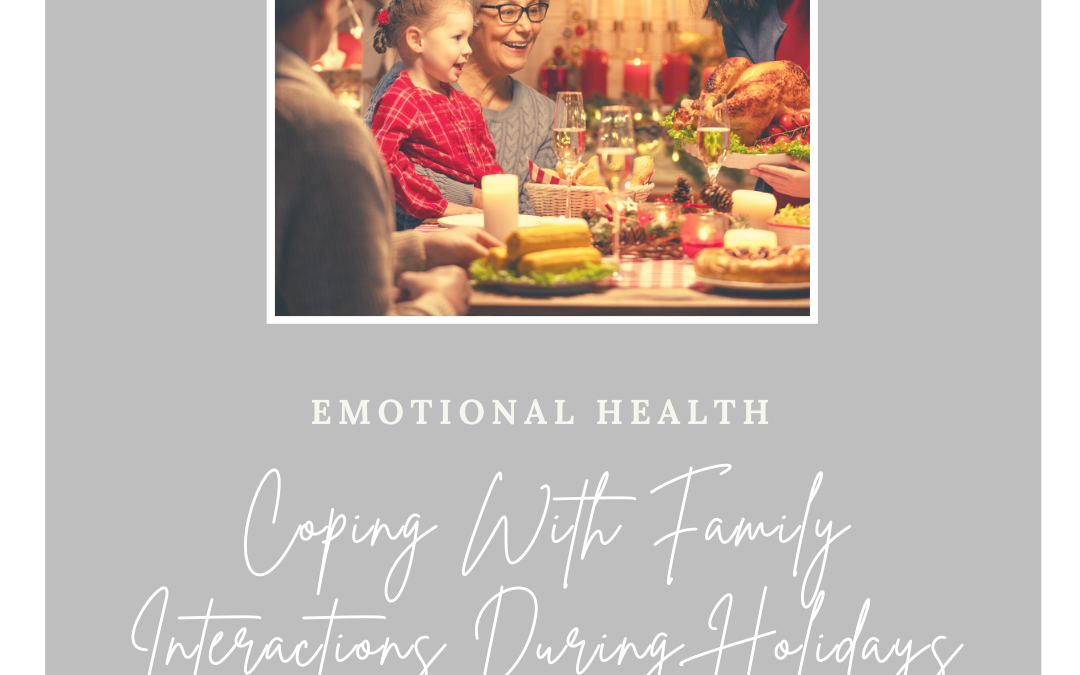
The holidays can be a special and memorable time of year for many, filled with laughter, gift-giving, words of affirmation and connection. But it can also be filled with tension, anxiety, and disappointment for those struggling with challenging relationships with family members. Many people have strained family relationships, or possibly even unresolved traumas from childhood that make family interactions difficult. This can bring about triggers when interacting with these family members, and with triggers come efforts (either consciously or unconsciously) to cope with these triggers.
Some examples of unhealthy coping include defensive arguments, alcohol or other substance use, binge eating or restriction. These are coping skills that might numb us in the moment, but cause long term suffering or bring us further from a place of peace and happiness. We all have our ways of coping with stress, and sometimes we are aware of these coping skills, but sometimes we are not. Coping is how we deal with challenging or difficult situations in our life. Sometimes the anticipatory anxiety around family gatherings can be so great, that we are engaging in coping behaviors for weeks leading up to a family gathering.
It is important to become aware of the coping mechanisms that you use in the face of family conflict before you are faced with that family conflict. You cannot reduce the maladaptive, or unhealthy, coping mechanism until you know what it is. And you cannot take away one coping skill without replacing it with another one, so it is important to replace the maladaptive coping mechanism with a coping mechanism that meets your underlying needs associated with the trigger.
Thinking about patterns of behavior in family members, what is expected of your next family gathering? Is it an uncle who always brings up politics? An aunt who always comments on your appearance or the food on your plate? A cousin who perpetrated abuse upon you as a child? Or a sibling who instigates an argument about even the most arbitrary topics? Regardless of what the triggering statement might be, it is important to explore the underlying need you have associated with the trigger. Perhaps you need to feel heard, to feel safe, to feel respected, to feel autonomous, to feel loved. Maybe it is to feel numb to the emotional pain you experience. Every person has needs, and when these needs are not met, we feel the need to use coping mechanisms to meet those underlying needs.
When you consider the need(s) you have in the moment of the trigger, it is important to match the coping mechanism to your need. Here are some ideas for healthy coping to deal with triggers around the holidays:
- Before the event, journal about your thoughts and feelings about the family gathering. Process your feelings about the person you are anxious about interacting with. Write about situations where you felt triggered in the past and how you dealt with it. Write about the triggers you may face at this event and write about the ways you might be able to cope with it in the moment.
- Write a no-send letter to that person (and do not send it – you can be more unfiltered in your writing if you know that no one else will read it). Meditate on your unresolved feelings towards that person after writing the letter, and consider burning the letter safely in a fireplace, or dissolving it into a bowl of water, or ripping it into tiny pieces.
- Enlist a support system for yourself for this gathering before it happens. Perhaps it is a family member who will be at the event that you feel safe sharing your feelings with. If there is no one at this event who you feel comfortable speaking to about this, perhaps enlist a friend that you can call or text if you need to during the time of the gathering to feel supported if something happens.
- Consider setting healthy boundaries at the time of the trigger if it is safe for you to do so. This can be as simple as saying “I would rather not talk about this subject,” or “Please do not comment on ____,” or changing the subject entirely.
- Write positive affirmations or statements to yourself before the event, and put them in a place you can access them when you need to, such as your pocket, your wallet, your phone case, or in your car. Match this affirmation with the need you have associated with the trigger, such as “I am enough,” “I can do hard things,” “I release all expectations placed upon me,” “I can stay calm in the face of adversity.”
- Excuse yourself for a step outside to take a few deep breaths or take a short walk around your block to clear your thoughts before returning to the conversation. When taking deep breaths, breathe in from your nose or your mouth to the center of your body, and try to count your inhale breath and your exhale breath. Try to make each breath longer with every inhale and exhale.
- Set up a support network for yourself after the family gathering. Maybe this includes calling a friend on your drive home (hands free, if you are the one driving), journaling about your feelings when you get home, or engaging in a healthy form of escape such as reading, gaming or watching a movie/show to take your mind off of things.
– Alejandra Rose, LMFT